How Does Autumn Humidity Change the Way Your Clay Behaves?
Quick Answer: Autumn brings higher outdoor humidity and, once the heating comes on, much lower indoor humidity, often within the same week. Clay dries by evaporation, and evaporation rate is governed by the humidity of the air around it. Heating dries a studio fast and unevenly, which is what produces the sudden run of cracked bases, warped rims and pots that go bone dry overnight when they used to take three days.
Your technique did not change. The air did.
Here is what to look at, in the order it matters.


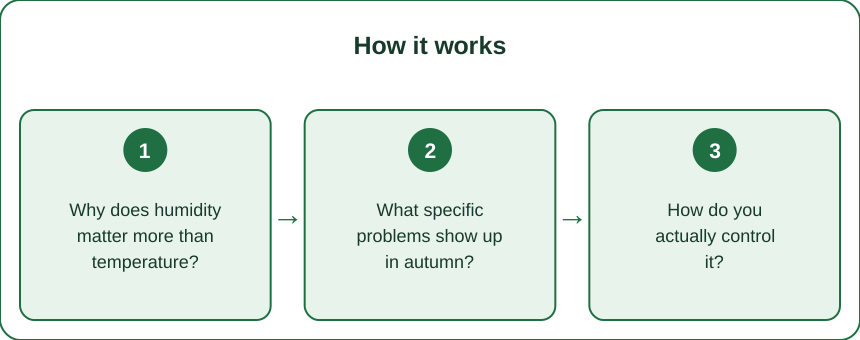
Why does humidity matter more than temperature?
Drying is evaporation, and evaporation depends on the moisture gradient. Water leaves clay at a rate set by how much moisture the surrounding air can still absorb. Dry air pulls hard; humid air barely pulls at all.
Temperature matters mainly because it changes humidity. Warm air holds more moisture, so heating a room without adding water drops the relative humidity sharply. A studio at 12C and 70% humidity becomes a very different environment at 20C with the heating on.
Uneven drying, not fast drying, is what cracks pots. If a whole piece dries quickly and evenly, it shrinks evenly. If the rim dries while the base stays wet, the rim shrinks against a base that has not, and that differential is the stress that opens a crack.
Radiators create the worst possible gradient. A shelf near a radiator dries the side facing it several times faster than the other side, which warps rims and cracks handles at the join.
Forced-air heating adds air movement, which compounds it. Moving air strips the saturated boundary layer off the clay surface continuously, and air movement is a bigger accelerator of drying than warmth alone.
And the change is abrupt rather than gradual. The heating comes on one day. Everything you know about your drying times was learned under different conditions, and it stops being true overnight.
What specific problems show up in autumn?
S-cracks in the base of thrown work. These come from compressed, wet centres drying at a different rate to the walls, and dry studio air widens that differential. Compressing the base thoroughly on the wheel matters more now than it did in July.
Rim warping on bowls and cylinders. The rim is the thinnest part and the most exposed, so it dries and shrinks first, pulling out of round.
Handles cracking at the join. A handle is thinner than the body it is attached to, so it reaches leather-hard first and shrinks against a wetter wall. This is the most common autumn failure in mugs.
Attachments popping off entirely. Same mechanism, further along.
Work going bone dry before you can trim it. Frustrating rather than fatal, but it changes your whole schedule and pushes people into trimming pieces that are too hard, which chips and chatters.
Uneven slip and glaze absorption. A pot that has dried unevenly has a different absorbency in different areas, so glaze goes on thicker in places and produces patchy results after firing that get blamed on the glaze.
And, from the other direction on damp weeks, work that will not dry at all. Before the heating goes on, cool damp autumn air can stall drying almost completely, which risks mould on plaster bats and slows everything down.
How do you actually control it?
Slow the drying rather than trying to speed it up. In autumn the problem is almost always too fast and too uneven, and the fix is plastic, not a fan.
Loose plastic over work, not tight. A tight wrap stops drying entirely and can encourage mould. A loose drape slows it while allowing gradual moisture loss, which is what you want.
Dry work upside down where the form allows. This slows the rim, which is otherwise the fastest-drying part, and lets the base catch up.
Move shelves away from radiators and vents. This single change fixes more autumn cracking than any technique adjustment.
Use a damp box or a covered container for anything you want to hold at leather-hard. Particularly useful for pieces you want to trim or attach to later in the week.
Get a cheap hygrometer. Knowing the studio is at 35% rather than 60% turns guesswork into a decision, and they cost very little.
Even out the walls at the making stage. Uniform thickness dries uniformly, and it is the most durable protection against every problem in this article. A pot with a heavy base and thin walls will always be at risk in dry conditions.

What Nobody Tells You About Seasonal Studio Changes
The transition weeks are worse than deep winter. Once the heating is on consistently, conditions are stable and you adapt. The problem is the weeks where it is on in the evening and off in the day, so your drying rate changes daily.
Your glazes change too. Glaze buckets settle and evaporate faster in a dry studio, so specific gravity drifts, and a glaze you have used for months starts going on thicker without you changing anything.
Bisque ware absorbs differently in dry air. A very dry bisque piece pulls glaze water in faster, giving a thicker coat from the same dip time.
Reclaim behaves differently. Slurry buckets and drying bats work much faster in a heated studio, and reclaim that was a week-long process becomes a two-day one.
Cold clay throws differently. Clay stored in a cold corner or an unheated garage is stiffer and more resistant, and people interpret that as their hands being off. Bring it into the warm the day before.
Plaster bats need watching in humid weeks. Before the heating comes on, cool damp studios can leave plaster damp enough to grow mould, which then contaminates reclaim.
And your firing schedule may need adjusting. Work that is not fully dry going into a bisque is at risk of steam explosions, and in a damp autumn week the piece that felt dry to the touch may not be dry through the base. Candling longer is cheap insurance.
How do you know if a piece is actually dry?
Touch it to your cheek. A piece that still holds water feels cool because evaporation is still happening. This is the oldest test and it remains the most reliable one available without equipment.
Look at the colour, but do not trust it alone. Dry clay lightens, and thick sections can be light on the surface and damp inside.
Check the thickest part. The base and any attachment joins are where residual moisture hides, not the walls.
Weigh it if you are unsure and it matters. A piece that has stopped losing weight over a day is dry. This is definitive and takes no skill.
Give it longer than you think in a damp week and less than you think in a heated one. Your sense of drying time is calibrated to conditions that have changed.
And when in doubt, candle the kiln longer. A slow, low hold at the start of a bisque drives off remaining moisture safely and costs a small amount of electricity, which is cheaper than losing a shelf of work and cleaning fragments out of the kiln.
FAQ: Autumn Pottery Questions, Answered
Why did my pots suddenly start cracking in October?
Almost always the heating coming on, which sharply drops studio humidity and creates uneven drying, especially near radiators and vents.
Should I use a fan to dry work faster?
Not in autumn. Air movement accelerates and unevens drying, which is the cause of most seasonal cracking. Slow it down instead.
How tightly should I wrap work in plastic?
Loosely. A tight seal stops drying entirely and risks mould; a loose drape slows it to an even rate.
Why are my handles cracking at the join?
The handle is thinner and dries and shrinks before the wall it is attached to. Wrap the handle area specifically or dry the whole mug more slowly.
Why has my glaze started going on too thick?
Dry studio air evaporates water from the glaze bucket, raising the specific gravity, and dry bisque absorbs faster. Check and adjust the bucket.
Is a hygrometer worth buying?
Yes. They are inexpensive and they turn a seasonal guessing game into a number you can act on.
TL;DR:
- Clay dries by evaporation, and humidity governs the rate far more than temperature does.
- Heating a studio drops relative humidity sharply and unevenly, which is what causes autumn cracking.
- Uneven drying, not fast drying, is the actual mechanism behind S-cracks, warped rims and lost handles.
- Slow drying down with loose plastic, move shelves away from radiators, dry rims down.
- Dry studios also thicken your glazes and speed up reclaim, so check specific gravity.
- Buy a hygrometer and candle longer when in doubt.
Your hands did not change in October. The air around your shelves did.
Keep Reading
This article is for general informational and styling purposes only. Fit, sizing, and product availability may vary.