Why Do My First Pottery Pieces Keep Collapsing on the Wheel?
Quick Answer: Most first-piece collapses happen because the clay was never fully centered before shaping began — an off-center start means the walls thin unevenly as the wheel spins, and eventually one side gives out.
You watched a dozen tutorials, your hands were wet, your wheel speed felt right — and the pot still folded in on itself at minute six. Here’s what’s actually going wrong.

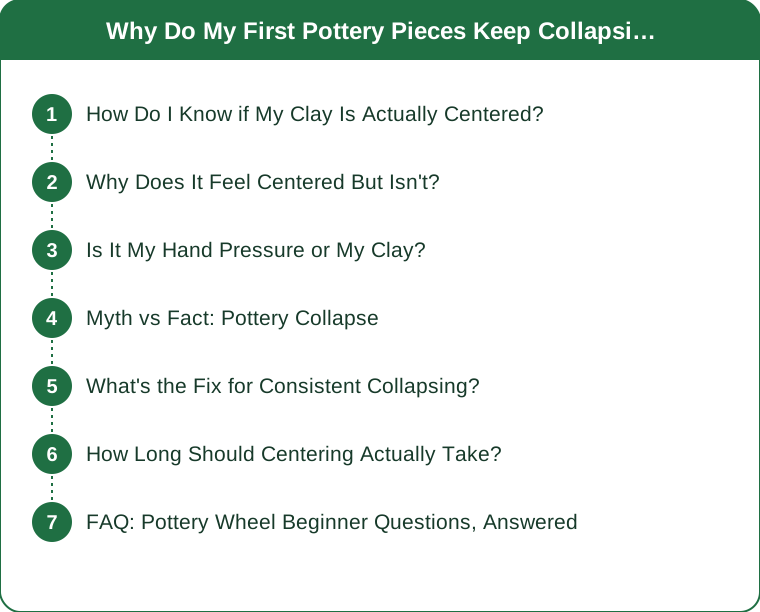
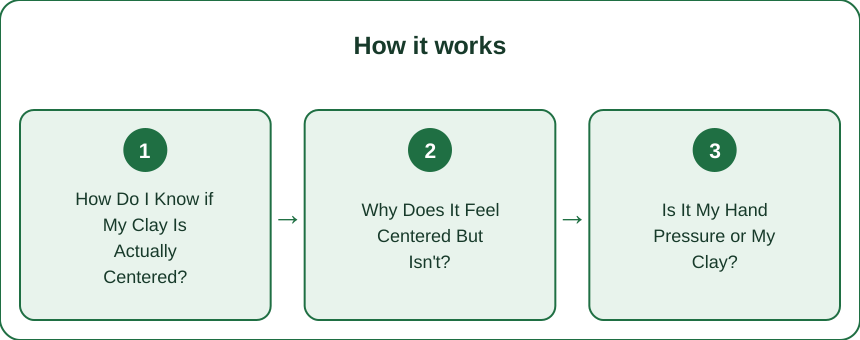
How Do I Know if My Clay Is Actually Centered?
A truly centered lump stays still under your hands even as the wheel spins — if you see any wobble at the top while your hands aren’t moving, it’s not centered yet. Most beginners stop centering 30-60 seconds too early because the clay looks round, not because it’s actually still.
Why Does It Feel Centered But Isn’t?
Your hands can ‘ride’ a slightly off-center wobble without feeling it, especially at higher wheel speeds where the eye and hand both get fooled by blur. Slow the wheel down to check — at low RPM, an off-center piece is obvious within two rotations.
Is It My Hand Pressure or My Clay?
Both matter, but pressure is the more common culprit. Centering needs firm, steady, unmoving pressure from both hands working together — one hand pushing in, the other pushing down and in. If your hands shake or ease off gradually instead of staying locked, the clay drifts back off-center the moment you release.

Myth vs Fact: Pottery Collapse
Myth: Collapsing means the clay is too wet. Fact: Wet clay makes it more forgiving of technique errors, actually — it’s usually thinning that’s uneven, from an off-center start, that causes collapse, not moisture content alone.
Myth: More clay makes centering easier. Fact: Beginners often do better with less clay (1-1.5 lbs) to start, since a smaller mass is faster to feel and correct.
What’s the Fix for Consistent Collapsing?
Before opening the clay at all, do a ‘compression check’: place both hands lightly on the spinning clay and watch for any movement in your fingertips. If you feel or see wobble, keep centering. Only move to opening once the clay has been still under light contact for a full 10 seconds.
How Long Should Centering Actually Take?
For beginners, 2-4 minutes of dedicated centering per piece is normal — rushing this stage to get to the ‘fun part’ of shaping is the single most common reason first pots fail. Experienced potters center in under a minute because their hands have learned the exact pressure, not because they skip steps.
FAQ: Pottery Wheel Beginner Questions, Answered
Is it normal for my first 5-10 pieces to fail?
Yes — most potters collapse or wreck the majority of their first several attempts. It’s a hand-feel skill that takes reps, not a sign you’re doing something fundamentally wrong.
Should I use a rib tool as a beginner?
A rib can help you see high spots while centering, but don’t rely on it instead of learning the hand-feel — use it as confirmation, not a substitute.
Why does my clay wobble again after I thought it was centered?
Uneven hand pressure during the transition to opening is the most common cause — keep your inside hand pressure steady as you switch from centering to opening.
TL;DR:
- Collapsing almost always traces back to incomplete centering, not wet clay
- Slow the wheel down to actually see wobble you might be feeling past
- Use less clay (1-1.5 lbs) while you’re building hand-feel
- Confirm stillness with a light-touch check before opening
- Give centering 2-4 minutes — rushing it is the #1 beginner mistake
The collapsing stops being a mystery once centering becomes a felt skill instead of a step you rush through.
Keep Reading
This article is for general informational and styling purposes only. Fit, sizing, and product availability may vary.