Why Does Clay Feel Different Every Time You Throw?
Quick Answer: Clay feels different session to session mainly because of moisture content changes (from storage and reclaim), room and hand temperature affecting how quickly it stiffens, and how recently it was wedged — not because of inconsistent skill, which is what most beginners assume.
Same bag of clay, same wheel, same chair — and today it’s fighting back where last week it centered in twenty seconds. That’s not a skill regression. That’s usually the clay itself behaving differently, for reasons that have nothing to do with talent.

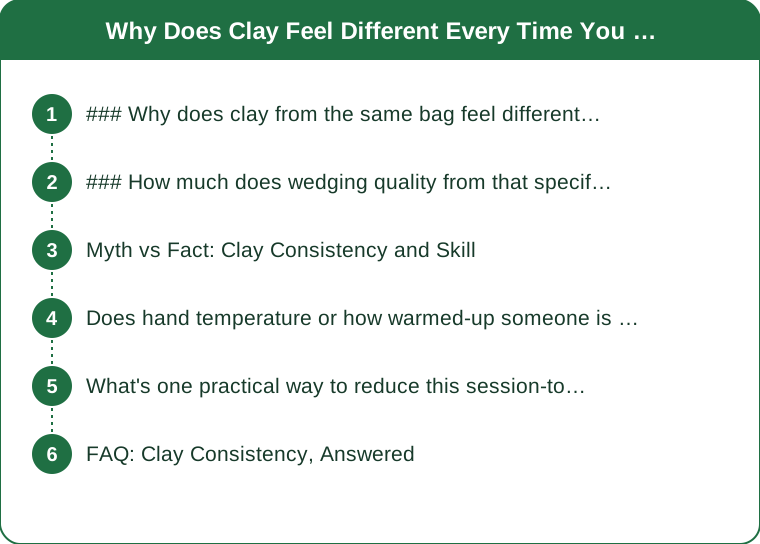
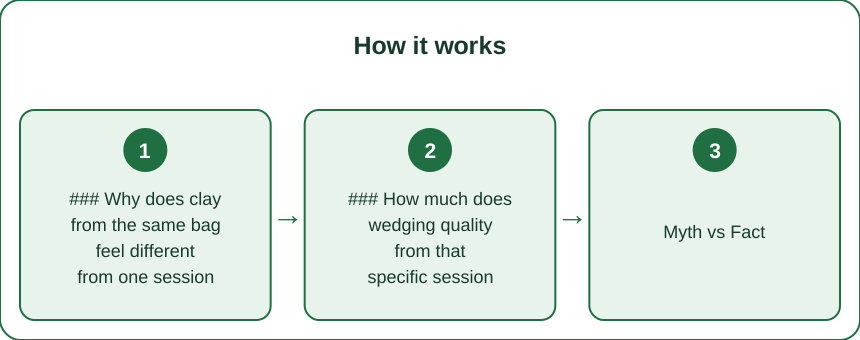
### Why does clay from the same bag feel different from one session to the next?
Moisture content is rarely perfectly uniform even within a single bag, and clay left partially sealed or stored in a warmer spot loses moisture faster than clay kept sealed in a cool area — a few percentage points of moisture difference is enough to noticeably change how the clay responds on the wheel, feeling either stiffer or wetter than the last session even though it looks identical.
Does room temperature actually change how clay behaves while throwing?
Yes — clay stiffens faster in a cold studio because the water within it moves and evaporates differently at lower temperatures, and hands throwing in a cold room also transfer less warmth to the clay, which further slows how pliable it becomes; a studio that’s 15 degrees colder than usual can make familiar clay feel notably tighter and more resistant to centering.
### How much does wedging quality from that specific session matter?
Wedging isn’t just about removing air bubbles — it also redistributes moisture evenly through the clay body, and a rushed or incomplete wedge leaves pockets of slightly different density and moisture that show up as uneven resistance while centering, making the clay feel like it’s fighting the hands unevenly rather than uniformly stiff or soft.
Does reclaimed clay behave differently than fresh clay from a new bag?
Often yes — reclaimed clay has usually been through a drying and rehydrating cycle at least once, which can change its particle structure slightly and make it feel a bit different (sometimes shorter or less plastic) than clay that’s never been reclaimed, even when the moisture percentage is matched carefully.
Myth vs Fact: Clay Consistency and Skill
Myth: If clay feels harder to work with than last time, throwing skill has gotten worse. Fact: Skill doesn’t fluctuate session to session the way clay moisture, temperature, and wedge quality do — a harder session is far more often explained by one of those physical variables than by any actual regression in ability. Myth: All clay from the same bag is uniformly consistent throughout. Fact: Clay near the surface of an opened bag dries out faster than clay in the center, so pulling from different spots in the same bag across sessions can genuinely produce different moisture levels.

Does hand temperature or how warmed-up someone is affect how the clay feels?
Yes, more than most beginners realize — cold hands transfer less warmth into the clay during the first few minutes of centering, which can make clay that would otherwise feel workable seem stiff and unresponsive at the very start of a session; many potters find the same piece of clay softens and becomes easier to work after the first few minutes purely from the hands warming both themselves and the clay through friction and contact.
What’s one practical way to reduce this session-to-session inconsistency?
Testing a small ball of clay by hand before sitting down at the wheel — checking whether it takes a fingerprint easily without sticking, or feels tacky and resistant — gives a quick read on that day’s actual moisture and temperature state before committing to centering a full piece, and adjusting expectations (or briefly wedging in a few drops of water, or letting a too-wet piece firm up for a few minutes) based on that quick check reduces the frustration of not knowing why a session feels off until well into a failed centering attempt.
FAQ: Clay Consistency, Answered
Can adding water mid-session fix clay that feels too stiff?
A small amount of water worked in gradually during wedging can help, but adding water directly onto clay already on the wheel tends to create an uneven wet layer on the outside while the interior stays stiff, so pre-wedging any water in beforehand works better than trying to fix stiffness mid-throw.
Is it normal for the same 5-pound ball of clay to feel different at the start versus 15 minutes into a session?
Yes — clay left sitting on the wheel head or wrapped loosely while other tasks happen can lose surface moisture within 15 minutes, especially in a dry studio, so noticeable stiffening partway through a session is common and not a sign anything is wrong with the clay itself.
Does clay type (stoneware versus porcelain) affect how much this session-to-session variation shows up?
Porcelain tends to be more sensitive to small moisture and temperature changes than many stoneware bodies due to its finer particle size, so potters working with porcelain often notice this inconsistency more sharply than those working with a more forgiving stoneware clay body.
TL;DR:
- Clay moisture content varies between and even within bags, more than most beginners assume
- Colder studio and hand temperature genuinely stiffen clay and slow its workability
- Wedging quality from that specific session affects how evenly the clay behaves while centering
- A quick hand-feel test before sitting down helps set realistic expectations for that day
A session that feels harder than the last one is rarely a sign of lost skill — it’s almost always the clay, the room, or the wedge telling a different story than usual, and learning to read those signals turns frustration into just another normal part of the process.
Keep Reading
This article is for general informational and styling purposes only. Fit, sizing, and product availability may vary.