Why Does Glaze Run Off the Pot and Pool at the Base?
Quick Answer: Glaze runs when it becomes more fluid than the firing schedule accounts for — usually from applying it too thickly, firing a cone hotter than the glaze wants, or using a glaze high in flux. Thickness is the cause about 70 percent of the time, and it is the easiest of the four to control.
The bowl came out beautiful from the rim to about an inch above the foot.
Below that, the glaze pooled, welded itself to the kiln shelf, and took a chip of the pot with it when it came free.


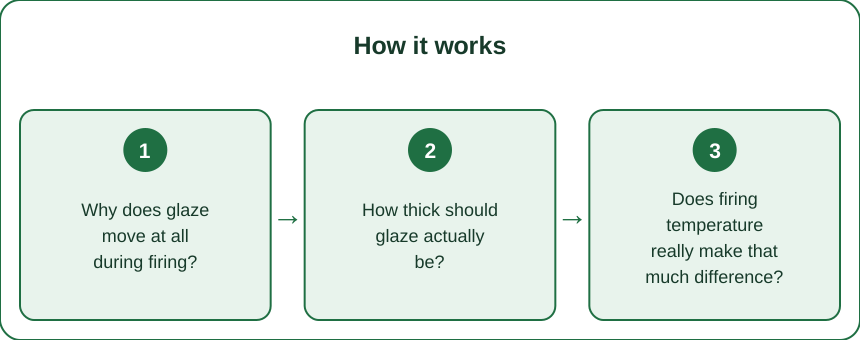
Why does glaze move at all during firing?
Because at peak temperature it is genuinely liquid, and gravity applies to it exactly as you would expect.
A glaze is a glass that melts onto the clay surface. Somewhere between cone 5 and cone 10, depending on the recipe, the ingredients flux into a molten layer with a real viscosity — thicker than honey, thinner than you might hope. It stays liquid for the whole soak at top temperature and for part of the cooling.
How far it travels depends on four things: how thick the layer is, how hot it got, how long it stayed there, and how much flux the recipe contains. Movement of 1 to 3 millimeters is normal and often desirable — it is what heals pinholes and gives a glossy glaze its depth. Movement of 10 millimeters is a problem, and the difference between the two is usually one extra dip.
Thickness matters more than any other single factor. A layer twice as thick does not run twice as far; it runs considerably further, because the mass driving the flow increases while the friction at the clay surface stays the same. This is why the same glaze behaves perfectly on one pot and floods on the next from the identical bucket.
How thick should glaze actually be?
Between 1 and 1.5 millimeters for most dipping glazes — roughly the thickness of a credit card.
Test it with your fingernail. Scratch the dried glaze near the foot. If your nail leaves a light groove and you can see clay under it easily, you are around the right thickness. If it takes real effort to reach the clay, you are too thick.
Or weigh it. Weigh the bisque pot, glaze it, let it dry, and weigh again. Most studios find a workable target between 4 and 8 percent of the bisque weight, depending on the glaze. Once you know your number, this is the most repeatable method there is.
Dipping time is usually 2 to 4 seconds. Longer than that and you are relying on the bisque having stopped absorbing, which it has not. Count out loud — people consistently overestimate how long three seconds is.
Bisque temperature changes everything about absorption. A pot bisqued to cone 06 drinks glaze far faster than one bisqued to cone 04. If your studio changed its bisque schedule and your glaze suddenly runs, that is very likely the cause and nothing about the glaze changed at all.
Does firing temperature really make that much difference?
Yes — a single cone is a large change in glaze fluidity, far larger than the temperature difference suggests.
One cone is roughly 20 degrees Celsius, and glaze viscosity drops steeply across it. A glaze formulated for cone 6 fired to cone 7 can run two to three times further. This is the second most common cause of running after thickness.
Kilns are not uniform. The bottom of an electric kiln commonly fires half a cone to a full cone hotter than the top, or the reverse depending on the element layout. If your runners are all from one shelf, you have found your answer without changing anything else.
Use witness cones on more than one shelf. A controller reading tells you what the thermocouple saw, not what the pot experienced. Cones tell you about heat work — the combination of temperature and time — which is what the glaze actually responds to.
A long soak acts like a higher temperature. Holding at peak for 30 minutes gives a glaze meaningfully more time to move than holding for 10. If you added a soak to fix pinholing and gained running, that trade is the reason.

Which glazes are most likely to run?
The ones that look best, unfortunately — and there is a reason for that.
High-gloss and flowing glazes are formulated to be fluid. Their appeal comes from movement, which heals surface defects and creates depth and variegation. A glaze marketed as flowing, cascading, or waterfall is telling you exactly what it will do.
High-flux recipes run more. Boron, lithium, and high alkali content lower the melting point and the viscosity together. Glossy commercial glazes tend to be flux-heavy for reliability of melt.
Layered glazes behave unpredictably. Two stable glazes layered can produce a mixture with a lower melting point than either alone — a eutectic effect. This is why layering is where most studio kiln shelf accidents come from, and why test tiles fired vertically are worth the effort.
Matte and satin glazes generally stay put. Their surface comes from crystals forming during cooling, which requires a stiffer melt. If you need reliability on a tall form, this is the safer family.
Vertical surfaces run and horizontal ones do not. The inside of a bowl can take a thicker coat than the outside wall of a vase, because gravity has nowhere to take it. Vary your application by orientation rather than treating the whole pot the same.
Myth vs Fact: Runny Glaze
Myth: Running means the glaze is defective. Fact: Almost always it means it was applied thicker or fired hotter than it was formulated for. The same bucket behaving differently between pots is the signature of application, not of a bad batch.
Myth: Wax resist on the foot solves running. Fact: Wax stops glaze from being applied to the foot. It does nothing to stop molten glaze from flowing down onto it during the firing, which is the actual failure mode.
Myth: Leaving a bigger dry margin at the base fixes it. Fact: It buys distance and it is genuinely worth doing — 6 to 10 millimeters unglazed at the foot for a suspect glaze. It is a safety margin, not a solution, and a badly running glaze will cross it.
Myth: You can sand off a glaze run. Fact: Fired glaze is glass. A diamond pad will grind a small run down and a stuck pot usually loses a chip of foot in the process. Prevention is genuinely cheaper than repair here.
Myth: Cookies under pots are for beginners. Fact: A bisque cookie sprinkled with kiln wash under any glaze you have not fully characterized is what experienced potters do. It costs one flat disc and saves a shelf, and the third mistake people make with a new glaze is skipping it on the very firing that needed it.
How do you actually stop it?
In order of what to change first.
Thin the application before touching anything else. Shorten the dip by a second, or add water to the bucket and check with a hydrometer — most dipping glazes work between 1.45 and 1.55 specific gravity.
Leave 6 to 10 millimeters unglazed at the foot. Wipe it with a damp sponge after glazing rather than trying to be neat during application.
Fire a cone cooler, or drop the soak. If the glaze is right at its upper limit, a cone 5 firing with a longer soak often gives you the same surface with far less movement than cone 6.
Use a bisque cookie for anything uncertain. A flat bisque disc, kiln-washed, under the pot. It turns a shelf disaster into a discarded cookie.
Fire test tiles vertically, not flat. A flat tile tells you the color. A vertical one tells you how far it moves, which is the information you actually needed.
Record what you did. Dip time, specific gravity, cone, shelf position. Runny glaze is a solvable problem and completely unsolvable without notes.
FAQ: Glaze Running, Answered
Can I fix a pot that has already run onto the shelf?
Sometimes. Once cool, tap gently with a wooden mallet at the join — often it releases with a small chip out of the foot, which can be ground smooth with a diamond pad. The shelf will need grinding and re-washing. A piece that has run badly is rarely food-safe at the foot afterward.
Why did the same glaze run on one pot and not another in the same firing?
Application thickness and shelf position, in that order. A pot that spent a second longer in the bucket carries noticeably more glaze, and the bottom shelf of most electric kilns runs hotter than the top. Both effects are larger than people expect.
Does the clay body affect whether glaze runs?
Yes, in two ways. A more vitrified body absorbs less glaze during dipping, so the same dip time leaves a thicker layer. And a smoother, less textured surface gives the molten glaze less to hold onto. Switching clay bodies is a legitimate reason for a glaze to start running with no other change.
TL;DR:
- Glaze runs when it is applied too thick, fired too hot, soaked too long, or is simply a high-flux recipe.
- Target 1 to 1.5mm — a credit card’s thickness — and dip for 2 to 4 seconds rather than by feel.
- Leave 6 to 10mm unglazed at the foot and use a bisque cookie for any glaze you have not characterized.
- Test tiles fired vertically tell you about movement; flat ones only tell you about color.
Runny glaze looks like a glaze problem and is almost always an application problem. One second less in the bucket fixes more pots than any recipe change will.
Keep Reading
This article is for general informational and styling purposes only. Fit, sizing, and product availability may vary.