Why Does My Finished Pot Feel Heavier Than It Should?
Quick Answer: Excess weight in a thrown pot is nearly always in the bottom third — the base and the lower wall — because that is where clay collects during centring and opening and where the wall is hardest to thin from the inside. A base left at 15mm instead of 8mm can add a third to the total weight of a mug. Weight also comes from glaze absorbed by a porous body and from clay type. Trim from the outside bottom first; that is where the fix lives.
Most people respond to a heavy pot by trying to throw thinner walls next time.
The walls were usually fine. The base was not.


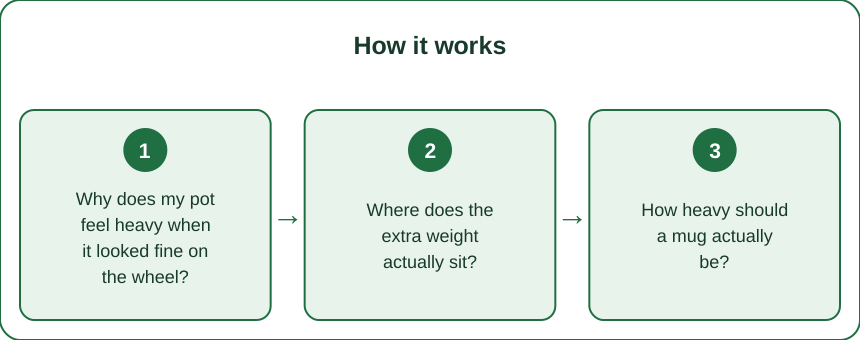
Why does my pot feel heavy when it looked fine on the wheel?
Because you were looking at the part that was already thin.
On the wheel, you are watching the rim and the upper wall — the parts you can see, feel between your fingers, and directly control. Those tend to come out well, because that is where your attention is.
The base is different. You cannot see it, you cannot feel both sides of it, and during opening you set its thickness in the first thirty seconds of the process, before you have any sense of how the pot will turn out. Clay also naturally accumulates at the bottom of the wall as you pull upward — every pull moves some clay up, but the transition from base to wall is the hardest spot to move it out of.
So you end up with a pot whose top two-thirds is genuinely elegant and whose bottom third is carrying twice the clay it needs. In the hand, the weight and the low centre of gravity are all you notice.
The classic tell: the pot feels bottom-heavy, not just heavy.
Where does the extra weight actually sit?
Almost always in one of three places, in order of frequency.
1. The base thickness. A mug base wants to be around 6 to 8mm after trimming. Left untrimmed, that same base is often 12 to 18mm. Because the base is a full disc, extra thickness there adds far more mass than the same extra on a wall.
2. The lower wall, in the first 15 to 20mm above the base. This is where clay collects and where a rib or your fingers struggle to reach cleanly.
3. The foot ring, or the lack of one. A solid untrimmed bottom is a slab of clay. A trimmed foot ring removes the centre of that slab while keeping the strength at the edges, which is exactly why foot rings exist.
A quick diagnostic before you trim: tap the base with a fingernail. A thick base gives a dull thud; a base close to the right thickness gives a higher, more resonant click. It is not precise, but it tells you which pots need attention.
How heavy should a mug actually be?
There is a usable range, and most beginners land well above it.
For a standard 300ml mug, fired weight commonly falls between 280g and 400g in stoneware. Under 280g starts to feel delicate; over about 450g is where people describe it as heavy. Handmade pots are legitimately heavier than factory ones — slip-cast commercial mugs are often around 250g — and a bit of heft reads as handmade rather than as a fault.
Some useful reference points:
- Bowl, 500ml: roughly 350g to 500g
- Small plate, 20cm: roughly 400g to 600g
- Mug, 300ml: roughly 280g to 400g
The more useful measurement is not absolute weight but balance. Fill the pot with water and hold it. If it feels like it wants to pull downward out of your hand, the base is too heavy relative to the walls, and no amount of overall thinning fixes that specific sensation.

Does trimming really remove that much weight?
Yes, and it is the highest-return five minutes in the whole process.
Trimming a base from 15mm to 8mm on a mug removes a disc of clay roughly 7mm thick and 70mm across. That is on the order of 25 to 40 grams of wet clay — often 10 to 15 percent of the total weight of the pot, taken off in about three minutes.
Cut a proper foot ring and you remove more, because you are hollowing the centre while leaving a supporting rim.
A few things that make trimming actually work:
- Trim at true leather-hard. Too wet and it smears; too dry and it chips and fights the tool
- Centre carefully. An off-centre pot gets trimmed thin on one side and left thick on the other, which is worse than not trimming
- Check as you go. Tap, or hold the pot up to a strong light — many clay bodies show a glow when the base is getting close
- Stop earlier than you want to. Trimming through the base is a specific kind of heartbreak
If you only change one habit, trim every pot rather than only the ones that obviously need it.
Why do two pots the same size weigh different amounts?
Three variables, and only one of them is your throwing.
Clay body. Different clays have genuinely different densities. A grogged stoneware and a smooth porcelain of identical volume will not weigh the same, and a heavily grogged body feels noticeably chunkier.
Firing temperature and vitrification. A body fired to full vitrification is denser than the same body underfired. This is also why an underfired pot can feel light and yet be more fragile — less glass has formed in the body.
Glaze absorption. A porous bisque drinks glaze. A thick glaze application on a thirsty body can add several percent to final weight, and much more if you glazed twice or dipped for too long. A pot that felt right at bisque and heavy after glaze firing usually got a heavy glaze coat.
So if your pots vary and your throwing has been consistent, look at the glaze step before you blame your hands. A five-second dip and a fifteen-second dip are different pots.
What Nobody Tells You About Pot Weight
Weight is a design decision, not just a skill measure.
Beginners treat thin as the goal because thin looks skilled. But a soup bowl that keeps soup warm benefits from a bit of mass, a mug for a hot drink is nicer with some thermal buffer in the walls, and a plate that is too light feels flimsy on a table. Thin walls are genuinely better for teapots and for anything you hold for a long time. They are not automatically better everywhere.
Where the weight sits matters more than how much there is. A 380g mug with an even wall and a trimmed foot feels good. A 380g mug with a 15mm base and thin walls feels bad, and people will describe it as heavier than the first one even though the scale disagrees. Your hand reads balance, not mass.
And the part almost nobody mentions: the handle. A heavy handle on a light mug throws the balance completely, and a handle pulled too thick is very common — it is the last step, you are tired, and it is easy to over-build. Weigh the handle in your mind against the pot before you attach it.
FAQ: Pot Weight Questions, Answered
Can I fix a heavy pot after bisque firing?
Barely. You can grind a little off the bottom with a diamond pad, which is slow and dusty and only removes a millimetre or two. The real window closes at leather-hard. Consider a heavy bisqued pot a lesson rather than a project.
Is a heavy pot weaker or stronger?
Usually neither, and sometimes weaker. Very thick sections dry and fire unevenly, which builds stress into the piece — thick bases are a leading cause of S-cracks. Even thickness is what makes a pot strong, not extra thickness.
How do I get a thinner base while throwing?
Set it during opening. After you open the clay, use a needle tool to pierce down to the wheel head, pull it out, and read the depth against your finger. Aim for 10 to 12mm wet, which trims down to around 7 or 8mm. Checking takes ten seconds and it is the single habit that most improves pot weight.
Does a wider foot ring make the pot feel lighter?
It does not change the mass, but it does change the perception — a well-cut foot ring lifts the pot off the table, catches the light, and reads as considered. People consistently describe pots with proper foot rings as lighter than untrimmed pots of identical weight.
TL;DR:
- Excess weight lives in the base and lower wall, not in the walls you were watching
- A base at 15mm instead of 8mm can add 10 to 15 percent of a mug’s total weight
- Trimming is the highest-return three minutes in the process — trim every pot, not just the obvious ones
- Balance matters more than absolute weight; a heavy base feels worse than a heavy pot
- Check base depth with a needle tool during opening and aim for 10 to 12mm wet
The next time a pot comes out heavier than you hoped, turn it over before you criticise your throwing. The answer is usually sitting right there on the bottom, and it is a problem you can solve at leather-hard on the very next piece.
Keep Reading
This article is for general informational and styling purposes only. Fit, sizing, and product availability may vary.