Why Most Beginner Pottery Failures Happen at the Wheel, Long Before the Kiln Is Ever Involved
Your bowl came out of the kiln cracked. Or warped. Or it survived bisque and then split during glaze firing, which somehow feels worse.
You’ve been blaming the kiln. Almost everyone does. The kiln is the last thing that touched it, it’s mysterious, and it’s the only stage you don’t watch.
The problem happened about four minutes into the session, before you’d shaped anything at all.
Quick Answer: Most beginner pottery failures trace back to centering — the wheel stage before any shaping begins. Clay that isn’t properly centered produces uneven wall thickness from the very first pull, and uneven walls dry and shrink at different rates, which is what cracks and warps a piece later. No amount of careful shaping fully corrects it. The fix is unglamorous: practice centering alone, with no attempt to make anything, until it’s reliable.

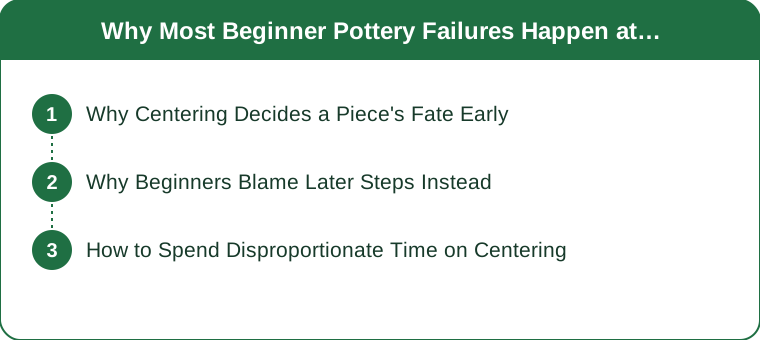
Why Does Centering Decide Whether a Piece Survives?
Because centering determines wall thickness, and wall thickness determines everything after it.
Here’s the chain. When clay isn’t perfectly centered, it wobbles as the wheel turns — the mass isn’t evenly distributed around the axis of rotation. Your hands stay in a fixed position, but the clay’s surface is moving toward and away from them with each revolution. So on the very first pull, you remove more material from one side than the other.
That’s the moment the piece is decided. You now have a wall that’s thicker on one side than the other, and that asymmetry is structural — it’s baked into the form before you’ve made a single shaping decision.
Why that matters later:
Clay shrinks as it dries and again as it fires. Thick sections dry more slowly than thin ones and shrink on a different schedule. The result is internal stress pulling the piece in inconsistent directions. Stress finds the weak point, and you get a crack or a warp.
Thin spots fail first. An uneven wall means the thinnest section is thinner than you’d ever have chosen deliberately, and it’s the first thing to go under thermal or mechanical stress.
You can’t fix it by shaping. This is the part that surprises people. Later pulls follow the wall you already have — you’re moving existing clay upward, not redistributing it. Trimming can even things out cosmetically at the foot, but it can’t rebuild a wall that was uneven from the start.
So the wheel, not the kiln, is where most beginner pieces are actually decided. The kiln just reveals the verdict.

Why Do Beginners Blame the Kiln Instead?
Because of when the failure becomes visible.
Nothing looks wrong at the wheel. A slightly off-center piece often looks perfectly acceptable when you set it on the shelf — you’d need a practiced eye to see the wall inconsistency. It looks fine through drying. It might look fine after bisque.
Then it cracks in the glaze firing, and the crack appears at a stage you were physically absent for.
Human attribution follows visibility. The failure showed up at the kiln, so the kiln becomes the suspect. It’s the same reasoning error as blaming the last thing that touched anything — the actual cause was invisible and hours earlier, and the visible event was just when the consequence arrived.
This misattribution is expensive, because it sends your effort to the wrong place. People respond by adjusting drying times, changing glazes, and asking about firing schedules — all reasonable-sounding, all aimed at a stage that was working correctly. Meanwhile the centering practice that would fix it doesn’t happen, because nobody suspects it.
A rough diagnostic: if your pieces fail in different ways at different stages but they were all a bit wobbly on the wheel, look at centering first. If your pieces are consistently even-walled and still failing, then investigate drying and firing.
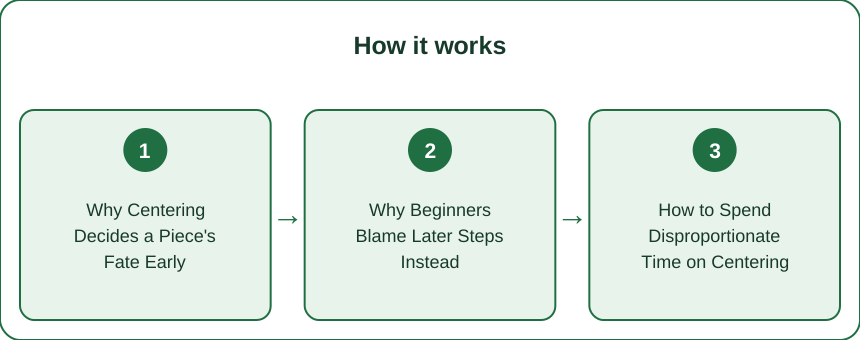
How Should You Practice Centering?
Alone, deliberately, and without making anything. This is the recommendation that beginners resist most and that changes results fastest.
Center and re-center the same clay. Take a lump, center it, then deliberately push it off-center, then center it again. Ten, fifteen, twenty times in a session. Never open it. Never pull a wall. You’re not producing anything — you’re training a specific skill.
This feels like a waste of studio time and it’s the opposite. A well-centered lump makes every subsequent step dramatically more forgiving, so time spent here pays back across every piece you’ll ever make.
What to actually pay attention to while you do it:
- Brace your arms. Elbows into your hips or thighs, or forearms on the wheel’s rim. Centering is done with body position, not arm strength — beginners exhaust themselves trying to muscle the clay because their arms are unsupported and drifting.
- Keep your hands still. The wheel moves the clay; you provide a fixed reference. Any wobble in your hands transfers straight into the clay.
- Steady, gradual pressure. Sudden force makes it worse.
- Close your eyes and feel for it. Genuinely useful. Centered clay feels smooth and still under your palms; off-center clay bumps against your hand once per revolution. Your hands detect this better than your eyes do, and learning to trust that feedback is much of the skill.
- Wedge properly first. Air pockets and inconsistent moisture make clay resist centering. Some centering problems are actually wedging problems.
How long? More sessions than feels reasonable. Centering is a physical skill on a normal motor-learning curve, and short frequent practice beats occasional long sessions. It’s also genuinely difficult — the frustration is standard, not a sign you’re unsuited to this.
Myth vs Fact
Myth: Cracks in the kiln mean something went wrong in the firing. Fact: Firing exposes existing structural weaknesses far more often than it creates them. Uneven walls, trapped air, and inadequate drying are the usual culprits, and all three happen before the piece reaches the kiln.
Myth: You can fix an off-center start by being careful during shaping. Fact: Later pulls follow the wall thickness that already exists. Trimming can improve the foot and the profile cosmetically, but it can’t rebuild a wall that started uneven.
Myth: Practicing centering without making anything is wasted studio time. Fact: It’s the highest-return practice available to a beginner, because it’s the step that determines the outcome of every later step. Producing five wobbly bowls teaches less than twenty focused centering attempts.
Myth: Centering is about arm strength. Fact: It’s about bracing and stability. Bracing your elbows against your body lets your skeleton hold the position while the wheel does the work — people who try to muscle it tire out and get worse results.
Myth: If it looks fine on the shelf, it was centered. Fact: Wall inconsistency is largely invisible from the outside. A piece can look completely acceptable and still carry the uneven thickness that will crack it three stages later.
FAQ
How long does it take to learn to center clay?
Most beginners need several sessions of dedicated practice before centering becomes reliable, and it varies quite a bit between people. Frequency matters more than session length, since it’s a motor skill — three short sessions across a week generally beats one long one. Persistent difficulty is normal and not a sign you’re doing something fundamentally wrong.
Why does my pottery crack in the kiln?
Uneven wall thickness is the most common underlying cause, since thick and thin sections dry and shrink at different rates and create internal stress. Trapped air from inadequate wedging and pieces that weren’t fully dry before firing are the other frequent culprits. All three originate before the kiln, which is why firing changes rarely solve a persistent cracking problem.
Can you fix a piece that wasn’t centered properly?
Not fully. Trimming at the leather-hard stage can even out the foot and improve the profile, which helps cosmetically, but it can’t correct wall thickness that was uneven from the first pull. If a piece is noticeably off-center early on, recycling the clay and starting again is usually the better use of your time.
TL;DR:
- Centering, not firing, decides most beginner pieces. Off-center clay produces uneven walls from the very first pull.
- Uneven walls dry and shrink at different rates, creating the internal stress that cracks and warps a piece later.
- Later shaping can’t fix it — pulls follow the wall you already have. Trimming is cosmetic.
- The kiln gets blamed because that’s where the failure becomes visible, not where it was caused.
- Practice centering alone, with no shaping. Center, push off-center, re-center. Twenty times a session.
- Brace your elbows against your body. Centering is stability, not arm strength.
- Close your eyes and feel for it — centered clay is smooth under the palms, off-center clay bumps once per revolution.
- Wedge properly first; some centering problems are actually wedging problems.
Keep Reading
This article is for general informational and styling purposes only. Fit, sizing, and product availability may vary.