Why Your Glaze Develops Tiny Cracks (Crazing) After Firing — And What It Actually Means
Quick Answer: Crazing — the network of fine cracks in a fired glaze — happens when the glaze cools and contracts more than the clay body underneath it, creating tension that the glaze relieves by cracking; it’s caused by a mismatch in thermal expansion between glaze and clay, and while it’s often just cosmetic, it can affect food safety and durability on functional ware.
It’s one of the most common questions in a beginner’s first few months, mostly because it can appear on pieces that otherwise look perfectly finished.


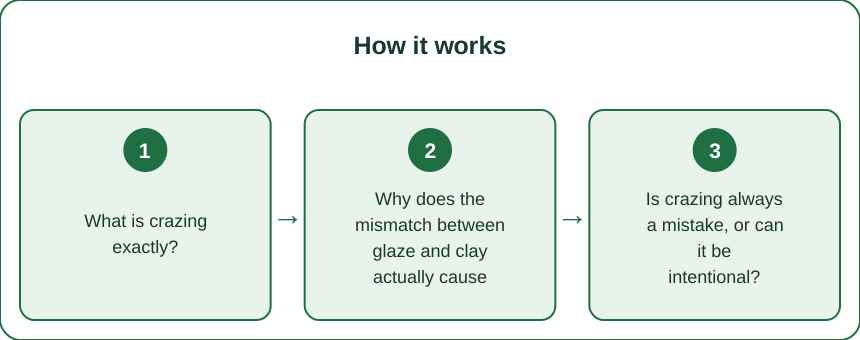
What is crazing exactly?
A network of fine, often hairline cracks across the glaze surface, visible either right out of the kiln or sometimes appearing days or weeks later as the piece continues to settle. It’s a surface-only phenomenon — the clay body underneath typically remains structurally intact.
Why does the mismatch between glaze and clay actually cause cracking?
Every glaze and clay body has its own thermal expansion and contraction rate. During cooling, if the glaze contracts more than the clay body beneath it, the glaze ends up under tension it can’t hold, and it fractures into the fine crack pattern known as crazing — essentially the glaze layer being squeezed into a smaller space than it wants to occupy.
Is crazing always a mistake, or can it be intentional?
It’s genuinely both — some potters use crazing deliberately as a decorative effect (often called a ‘crackle glaze’), sometimes rubbing ink or stain into the cracks to highlight the pattern. Unintentional crazing, though, usually signals a glaze-clay fit issue worth addressing for functional pieces.

Does crazing affect whether a piece is food-safe?
It can — crazed surfaces have tiny channels that can harbor bacteria and are harder to fully clean, which matters more for everyday functional ware (mugs, bowls) than for purely decorative pieces. For food-contact pieces, persistent crazing is generally worth correcting rather than ignoring.
What fixes crazing on future pieces?
Adjusting the glaze recipe (often reducing silica or adjusting flux content) or switching to a glaze formulated for the specific clay body are the most reliable fixes. Since crazing is a fit issue between two specific materials, the same glaze can craze on one clay body and not another.
What Nobody Tells You About Crazing
Crazing can sometimes appear weeks after firing, not immediately, as the piece continues very slowly settling into its final state — which is why a piece that looked flawless leaving the kiln can develop visible crazing later, confusing potters who assume something went wrong in a later use of the piece.
FAQ: Pottery Crazing Questions, Answered
Does crazing mean the piece is fragile or likely to break?
Not typically — crazing is a surface-glaze issue and rarely indicates the clay body itself is structurally weak, though severe crazing over time can very slowly affect surface durability.
Can a crazed glaze be re-fired to fix it?
Sometimes — applying a different glaze layer and re-firing can help in some cases, though it doesn’t always fully resolve an underlying fit mismatch and can be a bit of trial and error.
Is crazing more common with certain glaze colors or types?
Glossy, glassy glazes tend to show crazing more visibly than matte glazes, though the underlying mismatch cause is the same regardless of finish type.
TL;DR:
- Crazing is a network of fine cracks caused by the glaze contracting more than the clay body during cooling
- It’s sometimes used intentionally as a decorative crackle effect
- Crazed surfaces can be harder to keep food-safe on functional ware
- Adjusting the glaze recipe or matching it to the clay body is the most reliable fix
If a piece craziness weeks after firing surprises you, that’s a normal part of how the material settles — it’s worth noting which glaze-clay combination caused it so you can adjust for next time.
Keep Reading
This article is for general informational and styling purposes only. Fit, sizing, and product availability may vary.