Why Your Pot Warps in the Kiln: Every Question, Answered
Quick Answer: Warping is almost always caused by uneven wall thickness, uneven drying, or stress left in the clay from throwing — not by the kiln itself. The kiln only reveals it. Even walls, slow and even drying, and letting thrown pieces rest before trimming prevent the large majority of warps.
You opened the kiln, reached for the bowl you were most pleased with, and the rim is no longer a circle. The glaze is fine. The form is not.
The kiln gets blamed and rarely deserves it. Firing supplies the heat that lets stress express itself, but the stress was built in days earlier.
Below, the questions potters actually ask about warping, in the order they tend to ask them.


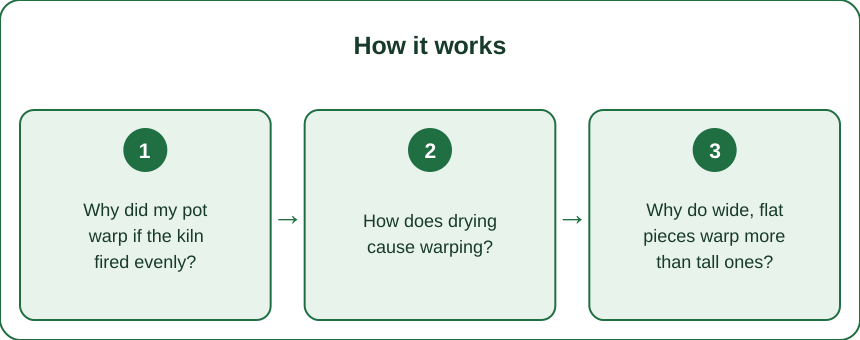
Why did my pot warp if the kiln fired evenly?
Because the kiln did not create the stress — it released it.
Clay remembers how it was made. Throwing aligns the platelets in the clay in a spiral. Under heat those particles want to relax, and where the alignment is uneven, the relaxation is uneven. The kiln is the moment the pot finally does what it wanted to do all along.
Uneven walls warp toward the thin side. A wall that is 4mm on one side and 7mm on the other shrinks at different rates through drying and firing. The thin side finishes first and pulls the form with it.
Vitrification softens the clay. Near peak temperature, especially at cone 6 and above, the clay body becomes genuinely slightly plastic. Any built-in stress or unsupported weight acts on the form during that window.
Does that mean an even kiln does not matter?
It matters, but less than people expect. Significant temperature differences across a kiln can worsen warping, particularly on wide, flat pieces. But if the piece has even walls and dried evenly, a modest kiln variation rarely warps it on its own.
How does drying cause warping?
Unevenly. Any part of a pot that dries faster shrinks sooner, and that difference is stored as stress.
Rims dry first, always. They are thin and exposed on both sides. A rim that dries hard while the base is still soft creates a tension ring that shows up as an oval later.
Handles and attachments are trouble spots. They dry faster than the wall they are attached to, and the join becomes a stress line. This is the single most common source of warping and cracking on mugs.
Air movement is the usual culprit. A piece near a window, a vent, or a fan dries on one side faster than the other. That asymmetry becomes a lean or an oval.
How slowly should I dry a piece?
Slower than feels necessary. Loosely cover with plastic for the first day or two, then vent gradually over another two to four days depending on thickness. For anything wide or flat, a full week of gradual drying is a reasonable target.
Should I dry pots upside down?
For plates, bowls, and wide forms, yes — once they are firm enough to handle. It lets the rim and base dry at more similar rates and takes the weight off the rim.

Why do wide, flat pieces warp more than tall ones?
Because a flat form has no structural geometry to resist movement, and it dries most unevenly.
A cylinder is self-bracing. The curve of a wall resists deformation the way a curved sheet of paper does. A flat plate has no such help and only needs to move a millimeter to look wrong.
Flat pieces dry from the top only. The bottom sits against a surface, so moisture leaves from one side. That differential is exactly the recipe for a curl.
They also sag under their own weight when hot. A wide unsupported span softens near peak temperature and settles. Firing on a flat, clean shelf with even support is genuinely important here.
What is the practical fix for plates?
Three things: keep the thickness genuinely even (check with a needle tool), dry them between two boards with a light weight for the first day, and consider a slightly raised foot or an added curve for rigidity. A plate with even the gentlest dome resists warping far better than a truly flat one.
Can I flatten a warped piece after bisque?
Not meaningfully. Bisque is permanent in shape. Some potters have limited success re-firing a piece flat with weight on it at glaze temperature, but results are unpredictable and often make it worse.
Why did trimming make it worse?
Because trimming removes material unevenly and often happens before the stress from throwing has relaxed.
A pot recently thrown is still moving. Give a thrown piece a few hours — ideally overnight under loose plastic — before trimming. The walls equalize and the clay relaxes, and you are then trimming a stable form.
Off-center trimming creates thin spots. A pot re-centered slightly off will end up thinner on one side of the base. That thin spot dries faster and pulls the form.
Over-trimming the foot removes support. The foot ring is structural. Trimming it thin gives the base less to stand on during vitrification, and wide pieces then sag.
How thin is too thin?
As a rule of thumb, keep the base at least as thick as the walls, and aim for consistency within roughly a millimeter across the whole piece. Absolute thinness matters less than evenness — a consistently thin pot warps less than an inconsistently thick one.
Does compressing the base help?
Yes, considerably. Compressing the base with a rib during throwing aligns particles and reduces the tension that later shows up as S-cracks and subtle warping. It costs 20 seconds.
What Nobody Tells You About Warping
A small warp is usually invisible in use. A bowl 2mm out of round holds soup exactly as well. Potters notice warps that customers genuinely do not, and a great many pieces get discarded that did not need to be.
Some clay bodies warp more, full stop. Porcelain moves considerably more than stoneware because it vitrifies more and has less structure. If you have switched bodies and suddenly have warping, that is likely your whole answer.
Handles pull as they dry, not as they fire. Most handle-related warping happens in the first 24 hours after attaching. Wrapping the handle area loosely to slow its drying to match the body is a five-second habit that prevents it.
Kiln shelves are not flat forever. An old shelf with a slight bow will warp every wide piece placed on it, consistently and confusingly. Check yours with a straight edge — this catches out a lot of people who have been chasing the wrong cause.
Slow cooling can help. For pieces that soften near peak, a slower cool through the top few hundred degrees reduces settling. Many controllers make this a single programming change.
TL;DR:
- The kiln reveals warping; it rarely causes it. Stress is built in during throwing and drying.
- Uneven wall thickness is the number one cause — aim for consistency within about a millimeter.
- Dry slowly and evenly: cover loosely, vent gradually over several days, keep pieces away from vents and fans, dry wide forms upside down once firm.
- Let thrown pieces rest overnight before trimming, keep the base at least as thick as the walls, and compress the base while throwing.
- Wide flat pieces need extra care: even thickness, weighted drying, a slight dome or foot, and a genuinely flat kiln shelf.
- Porcelain warps more than stoneware, and a small warp is usually invisible in actual use.
Warping feels like bad luck at the kiln door, but it is nearly always traceable to a decision made three days earlier. Fix evenness and drying, and most of it simply stops happening.
Keep Reading
This article is for general informational and styling purposes only. Fit, sizing, and product availability may vary.